What should stay when an old tattoo changes?
An older tattoo can contain something worth keeping. It might be a subject you still love, a gesture in the drawing, or a place in a larger collection on your body. Wanting the work to change does not automatically mean wanting its entire identity to disappear.
That distinction is a useful starting point when considering a tattoo rework or cover-up in Tulsa. Here, rework means developing an existing image while retaining its recognizable identity. Cover-up means designing a new image around concealing or visually replacing the previous one. In practice, a larger project can contain both kinds of decisions.
Name the part you want to keep
“Make it better” leaves a great deal undecided. “Keep the flower, but reconsider the surrounding composition” gives the artist a clearer problem. So does “I like the subject, but the whole piece feels disconnected from the rest of my arm.” These statements separate attachment to the image from dissatisfaction with its presentation.
A hypothetical bird tattoo illustrates the difference. Preserving its pose while reconsidering nearby shapes keeps the bird at the center of the project. Replacing it with a botanical arrangement changes the subject. Neither choice is inherently more ambitious; they serve different intentions. A photograph and an individual assessment are needed before deciding what changes are practical.
Replacement can still connect with what remains
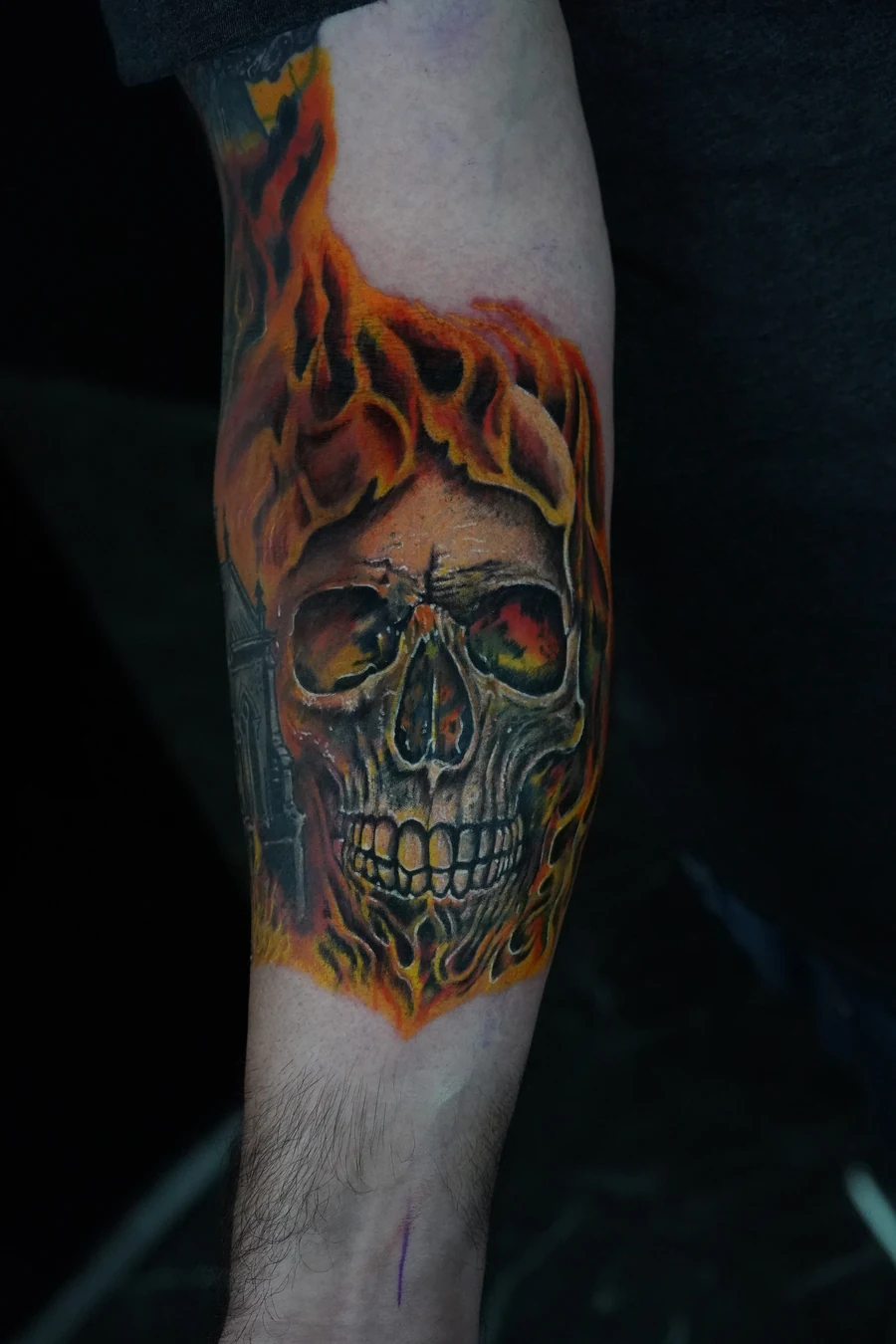
William Martz’s skull-and-flames cover-up shows a replacement motif meeting existing neighboring color. In the earlier photograph, flames already occupy part of the surrounding area. The finished skull and flowing fire continue that visual language.
This does not make the case a documented restoration of the old central motif. It is a cover-up whose composition pays attention to nearby work. That distinction is useful: replacing one part of an arm does not mean disregarding everything else on it.
The repeated warm colors give the new subject a relationship with its surroundings. The skull creates a focal point, while the flames provide movement at the edges. The journal study of the whole-arm composition follows that connection in more detail.
A new subject asks for different freedoms
In the raven case, the former rose is replaced by a bird with feathers and crossing wire. Keeping the rose recognizable was not the visible result. The change introduces a different silhouette, rhythm and subject across the forearm.
Compare that outcome with your own priorities. If a particular symbol must remain readable, say so before treating the project as an unrestricted replacement. If you are ready for a completely different subject, say that too. Those choices affect which parts of a drawing can move and which relationships need to survive.
Bigger changes are not automatically better changes
Adding detail everywhere can make it harder to understand what an image is about. A useful revision needs a clear purpose: reconnect a composition, strengthen a focal point or create a new subject. The desired change should be understandable without relying on the number of new elements.
There is also room to decide that a proposed direction asks you to give up something important. An old tattoo can remain meaningful even when it is imperfect. A drawing discussion should make that tradeoff visible before you commit to a different image.
William Martz’s artist page introduces his work across tattooing and painting in Tulsa. Looking through his portfolio with one question in mind—what do I want to preserve?—can make the next conversation more specific. Sometimes the answer is the subject. Sometimes it is the connection to nearby work. Sometimes it is simply the location where a new image will begin.