Tattoo sleeves in Tulsa: giving the whole arm a composition
A tattoo sleeve becomes visually coherent when its major shapes, focal points and transitions have a relationship to one another. Sharing a subject or a style can help, but it does not automatically make separate images feel like one composition. I think the larger question is how the eye moves through the arm.
For a sleeve tattoo in Tulsa, that might mean one continuous arrangement or a collection of distinct pieces with a shared rhythm. Both can be intentional. The amount of open skin, the distribution of dark areas and the placement of the strongest images all contribute to the result.
The whole image and the individual images
A sleeve can be encountered at different distances. From farther away, large shapes and contrasts establish its presence. Closer up, individual subjects and details become more apparent. I want those views to support each other.
That does not require every part of the arm to have equal visual weight. A dominant portrait might need quieter areas nearby. Several similarly sized subjects might need a recurring shape to connect them. If every element competes to be the center, the larger composition can become difficult to follow.
For me, hierarchy gives the individual pieces room to be seen. It is a way of deciding where the image speaks loudly and where it allows a pause.
Connections can be part of the subject
Transitions do not always need to be separate background material. They can come from the subjects themselves: a leaf, a curved band, a strand of rope or the overlap between two forms.
In Floral flow, large overlapping blooms and shaded leaves form a continuous arrangement along the arm. Curved petals and dark spaces between the flowers create connections within the botanical imagery.
That work is a useful example of continuity; I am not labeling the photograph as a documented full sleeve. The visual principle can inform a larger arrangement without changing what the source image actually shows.
Compass & flow demonstrates another approach. Curved bands and dark shading connect a compass, rope and anchor into a tall composition. Different objects become related through the shapes that pass between them.
A sleeve has more than one front view
An arm turns. A subject that dominates one view may become partly hidden in another, while a connecting shape moves forward. I see that changing visibility as a compositional opportunity.
The design can have several useful views without requiring every subject to be fully visible at once. A strong outside arrangement and a quieter inside passage, for example, would create a different experience from an evenly distributed pattern. Those are possibilities to consider, not rules that every sleeve must follow.
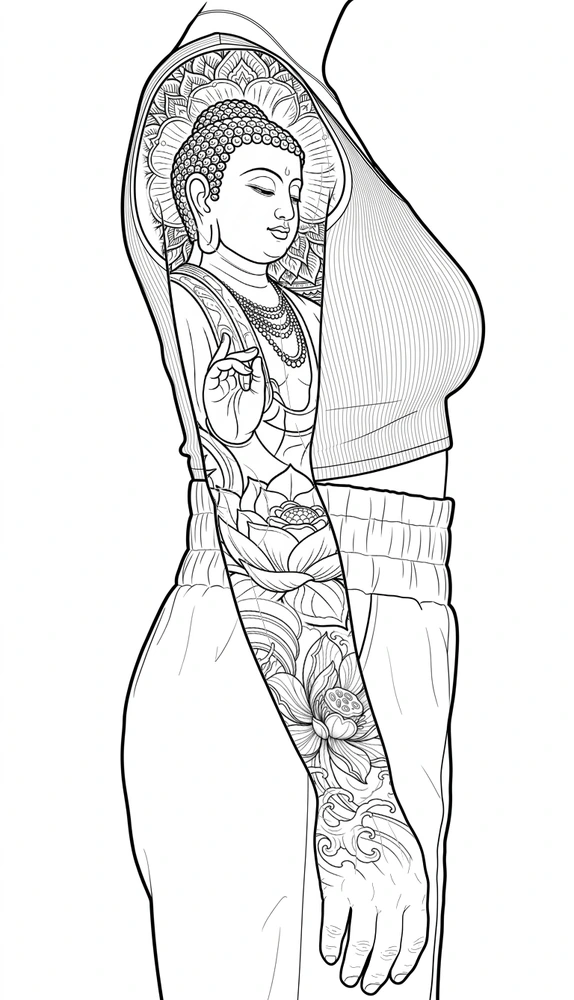
My Buddha and lotus sleeve study belongs to the arm placement studies in the design collection. It is a drawing study, not evidence of a completed sleeve. Such studies make the larger placement question visible before it is confused with the finish of a tattoo photograph.
Existing tattoos change the conversation
An arm with existing work brings its own scale, spacing and contrast. New elements need a considered relationship to what is already there, whether the intention is to keep pieces separate, connect them or explore a different overall composition.
I would not promise that every existing tattoo can be incorporated in the same way. The actual images and available space matter. Artistically, the interesting task is to find a larger arrangement that acknowledges those conditions and still has a clear direction.
A sleeve can be dense or spacious, unified by a story or connected through visual rhythm. What matters to me is that the arm feels considered as a whole. You can explore my completed tattoo portfolio and read about William Martz for the work behind that approach.