Forearm tattoos in Tulsa: composing for an arm that moves
A forearm tattoo needs a composition that makes sense on a moving, curved surface. The strongest arrangement is not necessarily the one that fills the most space. I look for a clear focal point, a direction that belongs to the arm, and relationships between shapes that remain interesting as the view changes.
This is why I do not think of the forearm as a narrow sheet of paper. A photograph can make it look flat for a moment. The person wearing the tattoo will see it from above, from the side and in a mirror. Other people will meet it from still more angles. Those changing views are part of the image.
Working with the length of the forearm
A long composition can follow the available space without turning into a stack of separate pictures. What connects the subjects matters as much as the subjects themselves.
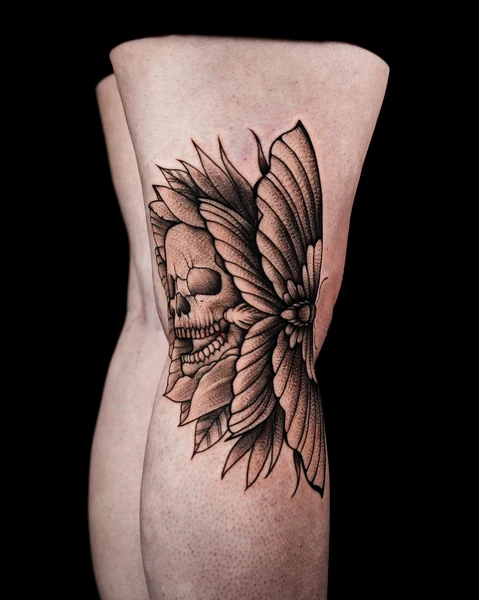
In my Skull & sunflower forearm tattoo, the skull and large flower form a vertical arrangement. Layered petals and fine shading connect them. The two subjects remain recognizable, but they also belong to one continuous piece.
That is a useful distinction when considering a forearm design. Placing one object above another establishes an order. Giving them related edges, overlapping shapes or a shared direction establishes a relationship. I am interested in that second step, where the arrangement starts feeling intentional rather than simply fitted into the available length.
A circular subject does not require a circular composition
A face, flower or compass can act as a visual center while other elements carry the image along the arm. The main subject and the overall outline do not need to have the same shape.
Compass & flow offers an example of this compositional principle. A compass, rope and anchor are connected by curved bands and dark shading in a tall design. I am referring here to the relationships visible in the work, rather than prescribing that arrangement for every forearm.
Curves can lead the eye around an object, while a longer element gives the piece direction. Used thoughtfully, that combination lets a rounded subject take part in a composition that suits a longer area of the body.
Direction changes the encounter with the image
People often want a universal answer about which way a forearm tattoo should face. I would rather consider the particular image and how the wearer wants to encounter it.
A figure with a strong gaze, a phrase with a clear reading direction and a flower with an open silhouette create different questions. Turning a design can change its relationship to the wrist, elbow and surrounding tattoos. The choice is more useful when it is made with those relationships in view.
There is no single orientation that makes every image look convincing. For me, the important point is that the direction feels considered rather than accidental.
Open skin belongs to the composition
Leaving space around a tattoo can make its outer shape easier to appreciate. Filling that space creates a different effect: continuity, density or a stronger sense of wrapping around the arm.
The Red butterfly near the wrist has open skin around its silhouette. Its spread wings follow the angle of the arm. That example shows how a clearly bounded image can have presence without occupying the entire surrounding area.
A larger forearm arrangement may call for a different balance. I think of the open areas and the tattooed areas together. Neither is automatically unfinished or excessive; their relationship is what gives the piece its character.
My Tulsa tattoo portfolio includes different approaches to that balance. You can also read about William Martz for the broader range of my work.