Custom tattoos in Tulsa: how an idea becomes a composition
A custom tattoo becomes personal through the decisions that shape it: what receives attention, what stays quiet, and how the image belongs on the body. Choosing an unusual subject is one possibility. Giving a familiar subject a particular expression, rhythm or relationship to the skin can be just as personal.
In my tattoo work in Tulsa, I think of the idea and the composition as two different things. “A bird,” “a portrait” or “something about change” gives us a starting point. A composition decides how that thought becomes visible. That is the part of custom design I find most interesting: translating something you can describe into something you can recognize without an explanation.
Finding the image inside the idea
An idea may arrive with several subjects, a few photographs and a sentence that matters. Each can contribute something. They do not necessarily need equal space in the tattoo.
I look for a visual priority. If the expression of an animal is the center of the piece, surrounding ornament can support that expression. If the movement of a flower is what matters, a rigid frame might fight it. Giving one element the lead makes the other decisions more meaningful.
This is an artistic judgment rather than a formula. Some compositions need a single quiet shape; others benefit from density. The useful question is what the arrangement makes you notice first, and whether that first impression belongs to the idea.
References give a drawing something to work with
A reference can communicate a color relationship, a face, an atmosphere or a kind of line. Those are different jobs. Separating them helps avoid a composition that becomes a collection of unrelated fragments.
For example, someone might like the curve of one image and the shadows in another. That does not mean both images need to appear literally. Their useful qualities can become part of a new drawing with its own structure.
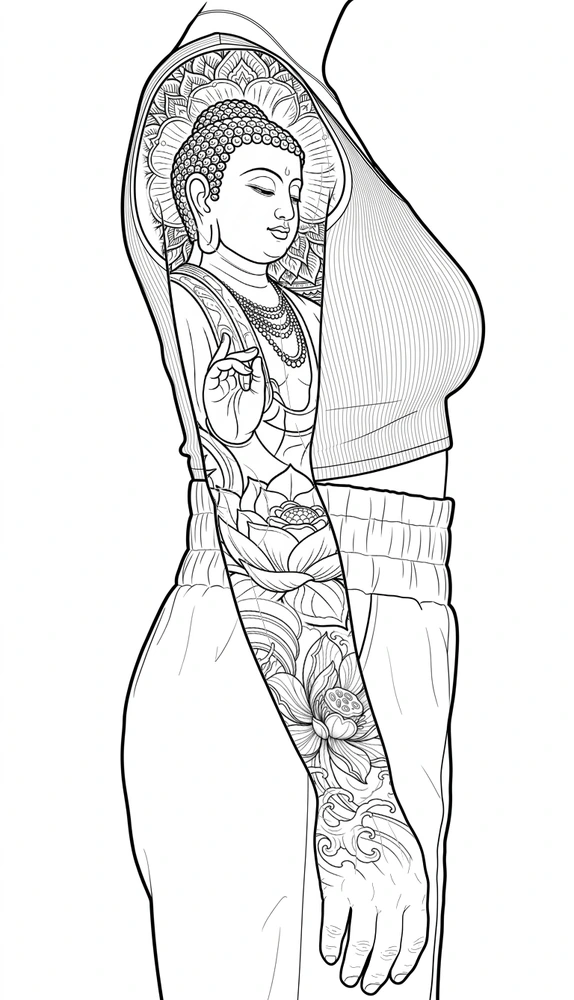
My tattoo design studies make some of that visual exploration visible. The Buddha and lotus sleeve study is specifically an arm placement study. It belongs to the drawing side of the portfolio; it is not a photograph of a completed tattoo. That distinction matters when looking at how an idea is being considered for the body.
The body changes the drawing
A rectangle on a screen gives every part of an image the same flat surface. An arm does something else. It turns, narrows and reveals different parts of the composition as it moves.
That can change the position of a face, the length of a stem or the distance between two objects. I see those adjustments as part of the design itself. A drawing can become more convincing when it stops trying to behave like a poster and starts responding to its placement.
The raven cover-up photographs show a different, concrete design problem: an existing tattoo, the stencil placement and the finished raven. The old image is already part of the surface the new composition must address. Layered feathers and barbed wire give the finished piece an organized visual structure. The sequence shows why placement is an active design decision, especially when there is existing work underneath.
A finished composition needs room to be itself
Custom work does not require every thought to become a separate symbol. Sometimes removing an element gives the central image more presence. Sometimes an additional shape provides the connection the drawing was missing.
For me, the goal is a tattoo whose parts belong together, whether it is quiet or elaborate, black and grey or color. The personal meaning can remain private. The image should still have a clear visual life of its own.
You can explore that range in my completed tattoo portfolio and read about William Martz and my work in Tulsa.