Painting-Inspired Tattoos: Giving a Night Sky a Clear Outline
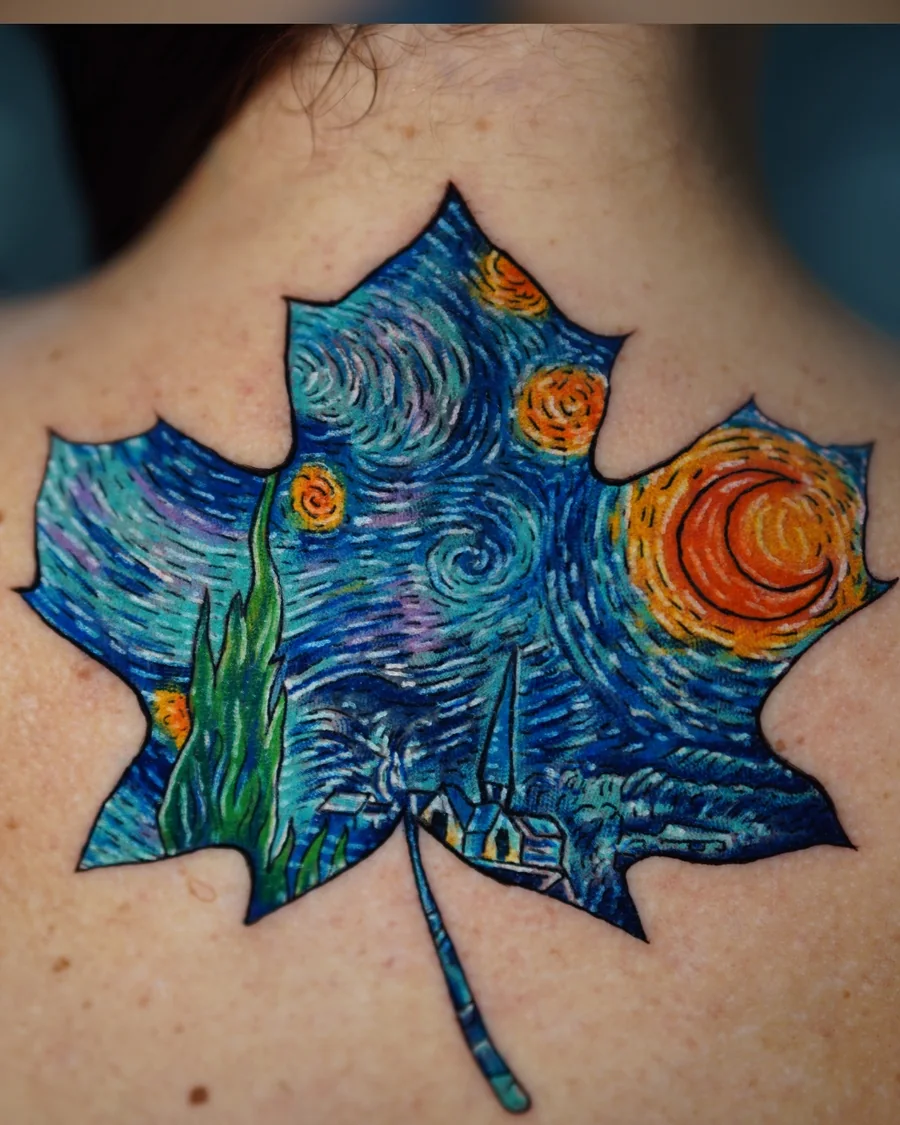
William's Starry maple holds a swirling blue-and-gold night scene inside a leaf. You can recognize the outline before looking into the small details. That outer shape is a useful place to start when turning a painting reference into a tattoo idea.
The leaf gives the sky its boundary
A recognizable outline gives the inner scene a container. In William's Starry maple, blue swirls and golden sky details sit within a maple leaf silhouette. The leaf and the night scene can be read separately, which makes their combination more legible than an undefined patch of small marks.
If a particular painting matters, bring its title and an image of the full work. MoMA's collection record identifies Van Gogh's The Starry Night as an 1889 oil painting. Use the source to point out the sky movement or color relationships you want to carry into a new composition.
Which details should survive a smaller format?
Identify the major color relationships, the strongest movement and one or two essential shapes. A painting's fine surface detail cannot simply be treated as equally important at every tattoo size. Ask what the viewer should recognize first if secondary details are reduced.
The container also changes the image. A circle, leaf or irregular silhouette will crop the inner composition differently. Compare the relationship between the largest bright shape and the edges rather than choosing an outline only because it looks decorative.
Must the result look like a miniature painting?
No. You can ask for a looser interpretation of movement and color instead. Be clear about whether you want recognition of a particular source or an independent image inspired by its atmosphere.
Bring the source artwork and the outline you like to your consultation with William. They answer two different parts of the design question.