Tulsa tattoo conventions: learning to look at the work
A tattoo convention can bring several ways of making images into the same room. Moving between artists' displays, a visitor may see a flower reduced to a few strong shapes, a portrait built through gradual shading or an ornamental drawing organized around repeated lines. The subjects may overlap while the visual decisions remain very different.
That makes a convention interesting even for someone who is not planning to be tattooed at the event. It can become a place to look carefully, discover artists and develop a clearer understanding of what attracts the eye.
Start with the organizer's current information
Homeward Bound Tattoo Expo is one event with an official Tulsa presence. Its organizer maintains event information and artist pages, providing a direct source for the current edition. Homeward Bound Tattoo Expo.
Dates, locations, participants and admission details can change between editions. This article deliberately does not repeat a calendar listing that may become outdated. The organizer's current information is the appropriate place to confirm the particular event being considered, rather than assuming that a photograph or announcement from an earlier year still applies.
An artist's presence also belongs to a particular edition. An old event photograph can introduce you to someone's work, but the current participant information establishes who is expected at the upcoming show.
Look at drawings as well as finished tattoos
A drawing can reveal how an artist organizes an image before the body becomes part of it. Notice where the darkest shapes sit, how the outline changes direction and which details repeat. Then look at photographs of completed work to see how that approach meets the curves and limits of a body area.
Those two views are related, but they are not interchangeable. A design displayed on a flat sheet has one set of boundaries. A tattoo on an arm or shoulder must work with another. Comparing them can make composition more visible than simply moving from one striking subject to the next.
It is also useful to distinguish finished photographs from documented healed work. A fresh image does not, by itself, establish how the tattoo has settled over time. The description attached to an image matters as much as its visual impact.
Compare how artists solve a similar image
One way to avoid visual overload is to follow a subject across different displays. With flowers, look at the shape of the petals and the space between them. With portraits, notice the relationship between the face and its surrounding elements. With decorative work, follow the rhythm of lines across the composition.
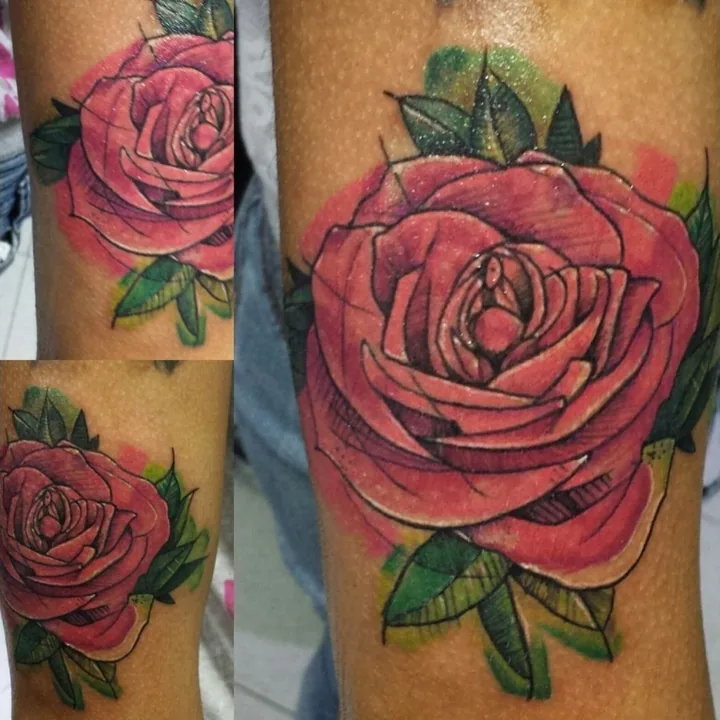
William's Rose Study provides one example to examine before or after such a visit. Its outlined petals contain several red and pink passages, while pointed green leaves extend the shape. Those specific observations give you something to compare, without declaring one approach the winner.
An artist working in another visual language may solve the same flower very differently. That difference is part of what makes seeing several portfolios together worthwhile.
Let the work remain more important than the spectacle
A busy booth, an award display or a large audience can attract attention. None of those details replaces looking at the actual artwork and understanding who made it. The energy of an event is one experience; choosing an artist for a particular project is another decision that deserves its own attention.
A convention can leave someone with a richer visual vocabulary rather than an immediate appointment. You may come away noticing stronger silhouettes, quieter backgrounds or more deliberate transitions between subjects. Returning to the portfolio with those observations can make familiar photographs more rewarding to study. The event has then offered something durable: a more attentive way of seeing tattoos.