Traditional tattooing: the strength of a clear image
A rose, a bird or a heart can appear in many kinds of tattooing. The subject alone does not determine the style. What changes is the way the image is built: the weight of its outline, the arrangement of its dark areas, the treatment of color and the amount of detail retained.
In this article, traditional refers to the American traditional visual language, rather than every tattoo tradition around the world. Its appeal is easy to feel in a strong drawing. The image presents itself clearly, with shapes that work together before the eye begins examining individual marks.
The outline gives the subject a structure
A substantial contour can establish the boundary of a wing, petal or face. Inside that boundary, other lines divide the larger shape into parts. When those lines have distinct jobs, the viewer can recognize the subject without needing every surface described.
This is a useful way to look at a traditional-style drawing: first notice the silhouette, then notice what happens inside it. If the outer shape carries energy, the image already has a foundation. Interior detail can reinforce that foundation instead of competing with it.
Simplification is a choice about emphasis. Leaving out a small detail can make a curve, an expression or a gesture more noticeable. The result can feel direct while still containing careful decisions about proportion and rhythm.
Color and darkness work as shapes
In many American traditional compositions, defined color areas sit beside black passages and open skin. The contrast between them helps organize the image. A limited palette can give individual colors distinct roles, while the darker parts anchor the design.
These are visual tendencies, not a checklist that every tattoo must satisfy. Artists interpret the language differently, and style boundaries can overlap. It is more useful to describe what is visible than to force every piece into a rigid category.
Nor does a style label guarantee how a particular tattoo will look years later. A photograph of completed work supplies evidence of that photographed moment; it should not be presented as a substitute for a documented healed image.
A rose offers a useful comparison
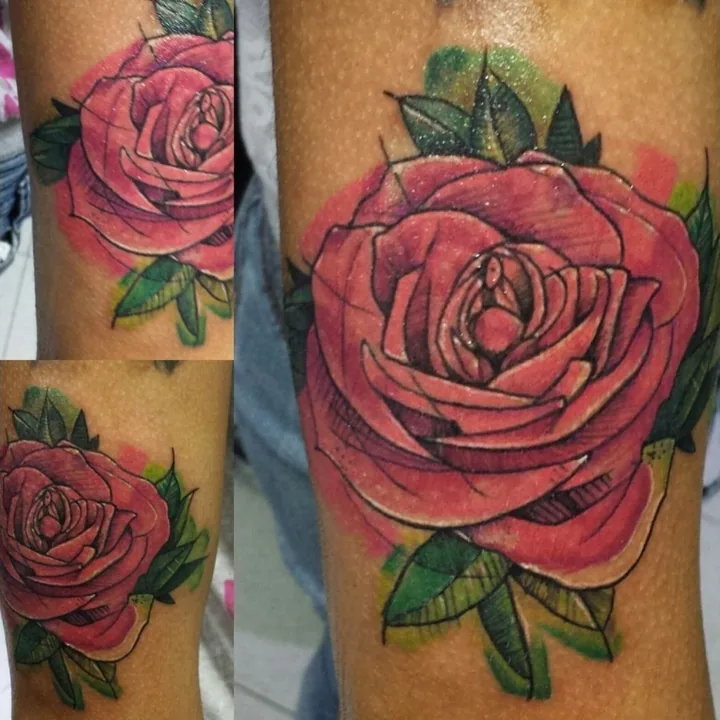
William Martz's Rose Study uses a recognizable outer shape and dark outlines around layered petals. Pink and red passages give the flower volume, and green leaves extend its silhouette. The collection of views makes the relationship between the flower and the body easier to see.
This is a comparison of visual decisions, not a claim that the piece is a strict example of American traditional tattooing. The outline, modeled petals and looser surrounding color can be considered separately. Looking closely at their interaction reveals more than attaching a single label.
It also shows why a familiar motif does not have to produce an identical image. The same rose can be redrawn with different proportions, line emphasis and shading, changing its character while retaining its identity.
Flash preserves the drawings as well as the motifs
Historical flash sheets let us look at tattoo imagery before it becomes a finished tattoo. Providence Public Library preserves flash and other tattoo artwork as a collection that records artists' designs and visual approaches. The archive helps make those drawings available for study beyond their original shop setting. Providence Public Library collection guide.
For a viewer exploring traditional tattoos in Tulsa, that attention to drawing is valuable. Notice the silhouette, the division of light and dark, and the rhythm of repeated shapes. Then compare those observations with the different approaches in William's portfolio. A style name can begin the conversation; the drawing shows what the artist actually does with it.