Sailors and tattoos: the history behind the maritime imagery
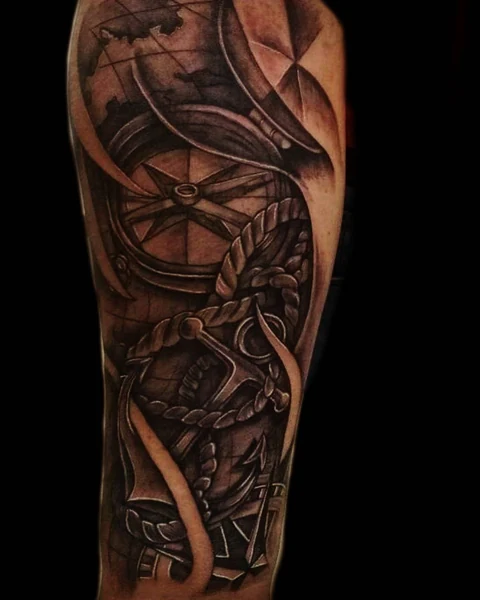
An anchor or swallow can make a tattoo feel maritime even when its wearer has never worked at sea. That familiarity comes from a long relationship between seafaring, travel and tattooing. Yet the history is more complicated than a dictionary assigning one permanent meaning to every picture.
Ships carried people between places, and those people carried images, stories and techniques. Ports provided meeting places and customers for tattoo artists. The surviving evidence includes official records, personal scrapbooks and objects from shops, each revealing a different part of that exchange.
Tattooing did not begin with a European voyage
The U.S. Naval History and Heritage Command notes evidence of tattooed seafarers before the eighteenth century. It describes Cook's Pacific voyages as an important encounter for Royal Navy sailors with Polynesian body art, while acknowledging tattooing's much older existence across cultures. Cook's crews belong in this history as participants in an exchange, not inventors of the practice. Naval History and Heritage Command.
That distinction changes the direction of the story. A European observer's written account may be familiar to an archive without being the beginning of the tradition it describes. The date a practice enters one institution's records is not necessarily the date people first practiced it.
One sailor's collection makes travel tangible
South Street Seaport Museum preserves material associated with Augustus “Gus” Wagner. Its collection account describes his travel as a merchant mariner and tattoo artist from 1898 to 1902, followed by a traveling career in the United States. Flash, hand tools and a large scrapbook connect the artwork to the movements of a particular person. South Street Seaport Museum's tattoo collection.
A scrapbook is especially useful because it can place different kinds of evidence beside one another. A postcard establishes a visual reference; a photograph records an appearance; a business card documents a professional identity. None tells the entire story alone, but together they make a career less abstract.
Symbols carry traditions, not automatic biographies
The Navy's account associates crossed anchors with the boatswain's rating and describes several voyage-related motifs. It also warns that tattoo lore often rests on oral tradition. Such associations help explain an image's history, but they do not allow a stranger to reconstruct every wearer's service or travels from a tattoo. Navy primer on sailors' tattoos.
A design may be inherited, adapted, chosen for someone else or appreciated for its appearance. Historical symbolism is one layer of meaning. A wearer's account is another. Confusing the two turns an interesting tradition into a false certainty about an individual.
Port history also survives on land
The Mariners' Museum's Coleman collection includes signed design sheets and a painted advertising figure from a Norfolk shop. These objects show the commercial surroundings through which maritime tattoo imagery reached customers. The Mariners' Museum.
For a tattoo reader in Tulsa, far from an ocean port, this history explains why nautical images remain culturally legible. Their movement did not stop at the waterfront. Looking at them today can involve both appreciation of a drawing and curiosity about the people who helped it travel. The most useful approach preserves that depth while leaving room for a modern wearer to give an old image a different personal significance.