The electric tattoo machine began with a different kind of pen
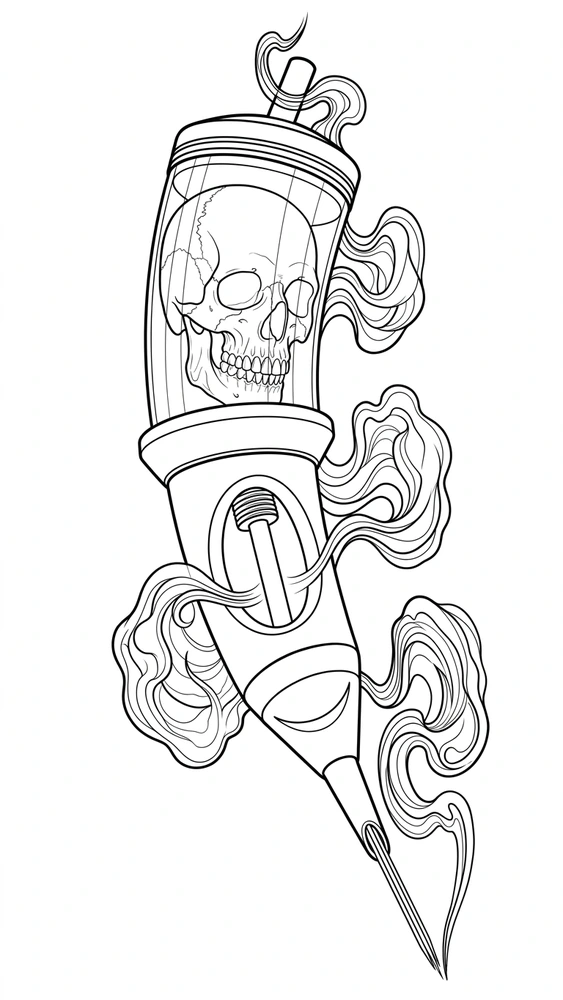
One of tattooing's important technological changes began with a device intended for office work. Thomas Edison's electric pen helped produce perforated stencils for copying documents. Its potential for another purpose would later attract the attention of tattoo artists.
The connection is memorable because it shows invention as adaptation. A tool developed for moving information across paper became part of a different craft, where the movement of a needle had to serve the making of an image on skin. The two devices were related, but they were not interchangeable.
From document copying to a tattoo patent
The Science Museum describes Edison's pen as a precursor to the electrical tattoo machine and identifies Samuel O'Reilly's adaptation and 1891 patent. The office tool belongs to a history of duplication; the tattoo machine belongs to a history of modifying that technology for another material and purpose. Science Museum: Edison's electric pen.
On December 8, 1891, O'Reilly received U.S. Patent 464,801. Smithsonian's Lemelson Center also identifies Charles Wagner's 1904 patent as an important later development in electromagnetic tattoo machinery. These records provide named inventors and dated designs, rather than a vague story in which “the machine” appeared fully formed. Smithsonian Lemelson Center.
What a patent can and cannot establish
A patent fixes a particular claim and drawing in the documentary record. That makes it a strong source for discussing a patented mechanism. It does not automatically document every experiment an artist made before filing, every machine in use elsewhere or the precise date a whole profession adopted a design.
This distinction is useful whenever tattoo history describes someone as the first inventor. “Received a patent in this year” is usually a more precise statement than “nobody had tried anything similar before.” The achievement remains important without making the evidence carry a larger claim than it supports.
It is also worth separating the invention of a powered tool from the invention of tattooing. Hand methods already existed. The new machine changed one means of making tattoos; it did not create the practice itself.
The working kit around the machine
The Smithsonian preserves a tattoo set from the 1920s–1930s that includes electrical fittings, needles, ink and containers inside a fitted wooden box. The object places the machine within an ensemble of tools. It also supports the museum's account of equipment designed to travel with American artists working around ports. Smithsonian: A Revolution in Tattooing.
Looking at a complete kit raises questions a patent drawing cannot answer. How were tools stored? Which parts traveled together? What survives through use, repair and replacement? The box and its contents offer evidence of work as an organized activity, not only an inventive moment.
Why the history still rewards attention
For someone seeing a tattoo machine at work in Tulsa, the historical connection makes the object less anonymous. It belongs to a sequence of adaptations, rather than being a neutral appliance that arrived without a past.
The machine still does not explain the whole image. A mechanism supplies motion; the artist must make decisions about the drawing, placement and visual relationships. Understanding the tool's history makes that division clearer. Technical invention enlarged the possibilities of the craft, while the quality and character of the work continued to depend on how people used those possibilities.